
A Yale study about zippers showed me what I'd been doing every Sunday morning.
I didn't leave Sunday morning in grief. I left the way a man leaves a room he's finally allowed to walk out of.
In 2002, two Yale researchers, Leonid Rozenblit and Frank Keil, asked people a simple question. How well do you understand how a zipper works? A flush toilet? A lock?
Everybody rated themselves high.
Then they asked them to explain it. Step by step, out loud. The ratings collapsed. They named it the illusion of explanatory depth. The feeling of understanding is not understanding. It's a feeling. And a feeling doesn't check its own work.
Now, I'd actually take the zipper apart. That's just how I'm wired. I don't let the feeling of knowing stand in for the real thing, I never have, I want to see the seams.
Which is probably why I didn't read that study and think about zippers.
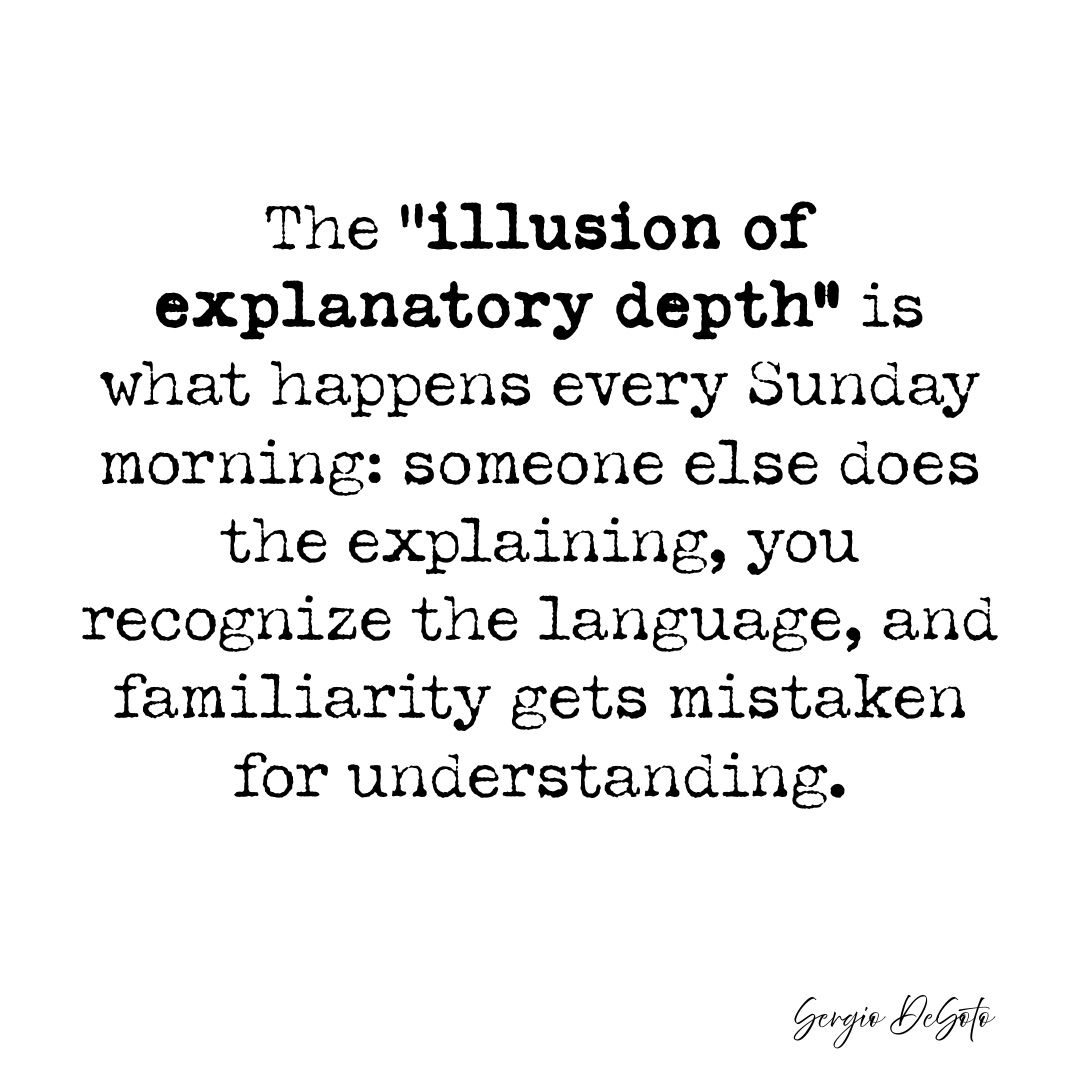
I thought about Sunday morning.
Because here's the thing I couldn't unsee, and believe me, I tried. I'll dismantle anything. An argument, a tax code, a database. I won't rest until I can walk it through. And then for years I'd turn around and accept the deepest claims a human being can make, claims about God, about judgment, about my own soul, on pure fluency. The songs are familiar. The voice up front is confident. The room nods. You leave feeling like you got it. Same brain that interrogates a zipper, handing the most important thing I claim to believe a pass I'd never give a zipper.
I sat with that for a long time before I did anything about it.
Most people think the fix is better teaching. Teach it sharper, close the gap. I don't buy it. I wanted to, it would have been easier, but I don't.
Because I already knew what good teaching looks like. One voice talking and a room listening sits at the bottom of every measure we have. You understand what you have to produce. You own what you had to defend to somebody who pushed back. Nobody pushes back on Sunday. Nobody is asked to produce anything. I knew the model ranked dead last, and I kept watching the faith deliver its highest-stakes content through it anyway.
And here's what kept nagging me. Scripture already told us the better posture.
Acts 17. Paul preaches at Berea, and Luke calls them more noble than the others. Why? They received the word with eagerness, and then they examined the Scriptures daily to see whether these things were so. Sit with that. They took apart the preaching of an apostle. Received it gladly, checked it anyway. And Luke doesn't scold them for it. He commends them.
So look at what we built instead. Luke praised the people who refused to run on the preacher's confidence, and we made a format that runs on nothing else. We call the nodder faithful and the examiner a troublemaker. We flipped the commendation on its head and didn't even notice.
So I left.
Not in anger. I want to be careful there, because it would be easy to hear anger. It wasn't that. It was a structural thing. The summary comes down the mountain already sealed. There's no return path. One voice down, no voice back up. You can be a Berean at home with the text, sure, but you cannot be a Berean with the preacher, because the preacher isn't available to be examined. And a summary you're not allowed to question, well, I don't know what to call that. It isn't teaching. It's secondhand authority wearing teaching's clothes.
And the more I turned it over, the more it felt older than the sermon. Go back to the mountain.
Exodus 20. The people hear the voice, see the fire, and they back away. They tell Moshe, you speak to us and we'll listen, but don't let God speak to us or we'll die.
Here's the part I think people skip. In Deuteronomy 5, God agrees with what they said. Their words were right. And then He says the thing that stops me cold every time: if only they had such a heart in them, to fear Me and keep My commands always.
Right words. Wrong heart.
That's the part that got me. It wasn't that they wanted a mediator. It's that they used the mediator as a wall. Correct language, kept distance. And I read that and thought, sound familiar?
Because that's the pew. That's exactly the pew. We send a man up the mountain so we don't have to go. We let him do the wrestling, the reading, the answering, and we receive the summary and call it faith. And the ignorance isn't an accident, that's the part that's hard to admit. It's the protection. If I never have to explain it, I never find out I can't. If I'm never examined, I never have to change.
Mediation is cheaper than accountability. And the mind takes the cheaper option every single time you let it.
So here's the door. And for the ones still behind the wall, it isn't a warm one.
Matthew 7. Yeshua describes people standing before him on that day. Not pagans. Religious people. They prophesied in his name, drove out demons in his name, did mighty works in his name. They had the vocabulary down cold.
And he says, I never knew you.
And notice what he names as the problem. Not bad theology. Not weak attendance. Lawlessness. They did the religious works and never did the will of the Father. And I used to read that as a second charge, but it isn't. In Hebrew thought, knowing and doing were never two things. Jeremiah 22:16 says it flat out. He defended the cause of the poor and needy. Isn't that what it means to know Me, says Adonai.
So knowing God was never a feeling you catch in a room. It's a life that got exposed and changed. Which means the illusion of explanatory depth in church was never just an intellectual problem. It's Sinai all over again. Right words, safe distance, no heart underneath.
You can't be known from the back row. And you can't be known through a mediator you hired to keep you safe.
So no, I don't carry grief about leaving. I carry the opposite, and it surprised me. What I found on the other side of that door wasn't loss. It was the first time my brain and my faith were finally allowed to do the same thing, in the same room, at the same time. Turns out the zipper instinct and the Berean command were one instinct the whole time. I just stopped nodding at sealed summaries and started examining the text to see whether these things were so.
That isn't the exit from faith. For me it was the beginning of it. The beginning of knowing. And of being known.
But I'll tell you the one thing that still sits heavy.
It grieves my heart how many people are blind to this. People I love. Sharp people, people who'd take apart anything you handed them, and they walk in Sunday and set that whole instinct down at the door and never ask why.
And lately it makes me wonder. Maybe that's why He called us sheep. I always heard that as a comfort. The Shepherd, the fold, the green pastures. But maybe I had it backwards. Maybe it was never a compliment.
I'm still sitting with that one.
Shalom v'shalvah.
Your brother in the Way,


10,000 Words
If one is worth a thousand, how about I give you ten.
2026 · 09 · 20 · 4 minWhy Mediation Never Delivers
If one man's off night can collapse a room's experience of God, what you had was never intimacy. Even God's own priesthood couldn't survive being made a mediator.
2026 · 09 · 13 · 3 min